Somewhere in the middle of a novel, the small questions start. Were her eyes gray or green? Is the island two hours from the harbor, or a whole day? Did he learn the secret in chapter 12 or in chapter 15? Each one takes a second to answer if you wrote it down, and an afternoon of rereading if you didn't.
A story bible is where you write it down. The idea comes from television. Writers pitching a series put together a show bible, and once the show is running, everyone working on it uses that bible to keep the characters and settings consistent from one episode to the next. Novelists took up the habit for the same reason: a book is written over months, and memory drifts.
The short version
A story bible is a reference file of the facts already true in your book: characters, relationships, places, routes, a timeline, world rules and a style sheet, plus the chapters each person and place appears in. Keep each fact to one line, note the chapter it comes from, and update it as you write. Jump to the story bible template.
What is a story bible, and do you need one?
A story bible is a record of the facts of your story: who the people are, where things happen, what happened when, and the rules your world runs on. Writers also call it a novel bible or a book bible, and when it spans several books, a series bible.
Some writers keep their plans in it too: scene ideas, possible conflicts, lines of dialogue they want to use. This guide keeps those in a separate list, so the bible holds only what is already on the page. That keeps it useful. When you need to check a detail, you check the bible, not your memory and not a plan you have since changed.
Not every book needs a thick one. You will get the most from a story bible if:
- You are writing a series, or a book that might grow into one.
- Your cast is large, or your characters go by more than one name.
- You have invented places, languages, magic or technology.
- The plot turns on who knows what, and when, as most mysteries and thrillers do.
- The book will take you months to write, or you are revising a draft you finished a while ago.
A standalone novel with five characters in one town may need a single page, and that page is still worth having. The details that drift are small ones: an eye color, a street name, someone's age, how many days have passed. A page of notes catches most of them. If you are still working out how long your book will run, here is how many words a novel needs, genre by genre.
One caution. In a piece on Jane Friedman's site, Rochelle Melander warns against letting the bible become more important than the book. Keep it lean. It is there to serve the draft.
What goes in a story bible
A full story bible has eight sections. Use the ones your book needs and leave out the rest.
| Section | What it holds | The detail that drifts |
|---|---|---|
| Characters | Names, nicknames, age, looks, personality, voice, wants and fears, backstory | Eye color, scars, ages, what people call each other |
| Relationships | Who is tied to whom, and how | Family trees, debts, who knows whose secret |
| Places | What each place is, how it looks, sounds and smells, and what sits inside what | Which floor the room is on, which side of the river |
| Routes and distances | How places connect, and how long the trip takes | A two-day ride that shrinks to an afternoon |
| Timeline | Events in the order they happened, with dates or a count of days | Ages in a flashback, the season, how many days have passed |
| World rules | Magic, technology, law, money, faith, travel | A spell that costs blood in chapter 4 and nothing in chapter 22 |
| Style sheet | Spellings, invented words, capitals, tense, point of view, numbers | Gray or grey, the Wardens or the wardens |
| Chapter tracker | Which characters and places appear in each chapter | A character who quietly vanishes after chapter 9 |
Characters
Start with what the reader has been told, then add what only you know. The fields that save the most rereading are the plain ones: full name and nicknames, age, hair and eyes, height, scars, the coat they never take off. Then the inner life: what they want, what they fear, how they talk. A line on voice, the words they use and the words they never would, keeps dialogue from blurring as the cast grows.
Relationships
Write each tie the way the story would put it: sister, rival, owes a debt to, secretly in love with. Note when a tie starts or changes. Relationships move during a book, and readers notice when two characters act like strangers a chapter after they became friends.
Places and routes
Give each place one line saying what it is, then the details that must stay the same: the layout, the weather, the smell of the harbor, who is allowed in. Nest them, a room inside a house inside a town, so you can find them again. Then write down how places connect and how long each trip takes. Travel time is one of the easiest things to get wrong, and in fantasy it is one of the first things readers catch.
Timeline
List events in the order they happened, which may not be the order the reader meets them. Use dates if your book has them, or count days from the opening scene. Add a column for who knows about each event. In a mystery, that column does a lot of the work.
World rules
If your world bends any rule of ours, write the rule down with its cost. Magic that costs nothing solves every problem, so readers expect a price, and they remember it. The same goes for technology, law, money and how fast news travels. Contemporary novels have rules too: a school timetable, a shift pattern, the hours a shop opens.
Style sheet
Copy editors make a style sheet as they edit a book: a list of its characters, places, invented words, capitals and spellings. Start your own early. List every name and invented word with its spelling and capitals, plus your choices on tense, point of view and whether numbers are spelled out. Proofreading goes faster when the decisions are already written down.
Chapter tracker
For each chapter, note who is on the page, where it happens and what day it is. Gaps jump out: the friend missing for ten chapters, the subplot that stops, two scenes on the same day in different cities.
The story bible template
Copy the blocks below into whatever you write in: a document, a spreadsheet, Scrivener or Notion. Each line is a field to fill in. Copy the Characters and Places blocks once for every person and place, and skip any section your book does not need.
Download the template
The same template as a Word file, with a table for each section and gray hints to type over. It opens in Word, Pages and Google Docs.
1. Characters · one block per person
Name: full name, spelled the way the story spells it
Also called: nicknames, titles, what each person calls them
Role: protagonist, antagonist, supporting or minor
Age: and a birthday, if the timeline needs it
In one line: who they are in the story
Appearance: hair, eyes, height, build, scars, what they always wear
Personality: temperament, habits, how they treat people
What they want, and what they fear: the goal that drives them, the fear that stops them
Voice: words they use, rhythm, tics, what they never say
Backstory: what happened before page one
Lives in: a place from your Places list
Knows: secrets they know, and since which chapter
First appears: chapter
Notes: anything else to keep straight
2. Relationships · one line per tie
Who and who: the two people
The tie: sister, rival, owes a debt to
Since: the chapter or year it started or changed
Notes: what each of them knows about it
3. Places · one block per place
Name: what the story calls it
Kind: realm, region, city, town, wilds, landmark, building or room
Inside: the larger place it belongs to
In one line: what this place is in the story
Description: sights, sounds, smells, weather, history
Layout: floors, rooms, doors, which side of the river
Rules here: who may enter, local laws, customs
First appears: chapter
Notes: anything else to keep straight
4. Routes and distances · one line per route
From and to: two places from your list
How: road, path, river, sea or a secret way
Time it takes: on foot, by horse, by car or by boat
Notes: when it is closed, what it costs, who knows it exists
5. Timeline · one line per event
When: a date, a day count or a character's age
What happens: one sentence
Who knows: everyone who knows it happened, and from when
Chapter: where the reader learns it
6. World rules · one line per rule
Rule: magic, technology, law, money, faith, travel, how news moves
What it costs or limits: the price, and what it cannot do
Exceptions: who can break it, and how
First shown: chapter
7. Style sheet
Tense and point of view: for example, past tense, close third person
Numbers and dates: digits or words, and how dates are written
Units: miles or kilometers, or your world's own
Names and invented words: spelling, capitals and how to say them
8. Chapter tracker · one line per chapter
Chapter: number and title
On the page: every character in the chapter
Places: where it happens
Day or date: from your timeline
Notes: threads opened or closed
A filled-in example
Here is one character, one place, one route and one event for an invented novel, to show how short each entry can be.
Example · invented for this guide
Wren Hollis. Also called Hollis by the crew. 34. Ferry pilot in Gullhaven. Gray eyes, cropped dark hair, a burn scar across her left palm, her father's oilskin coat. Calm until someone lies to her. Wants to keep the ferry running; fears the water at night. Short sentences, never swears, calls everyone by surname. First appears: chapter 1.
The Lantern House. Inside: Gullhaven. An inn on the quay, three floors, with the bar on the ground floor facing the water. Smells of tar and wood smoke. Shut on Sundays. First appears: chapter 2.
Gullhaven to Kell Island. By sea, two hours on the ferry. No crossings after dark.
Day 1, October. The night ferry does not come back. The whole town knows by morning. Chapter 1.
Notice what is missing: no essays, and no plans for the ending. If a fact is not in the book yet, it waits in a separate list of ideas until it is.
Story bible vs series bible vs outline
The three get mixed up, and each one does a different job.
| Document | What it answers | When you write it | When it changes |
|---|---|---|---|
| Outline | What will happen, and in what order | Before or during the draft | Whenever the plan changes |
| Story bible | What is true in this book | From the first chapter, as facts reach the page | When a fact on the page changes |
| Series bible | What is true across every book, and what each book changed | From book one, carried into each new book | During and after every book |
An outline is the plan; a story bible is the record. You can keep a story bible without an outline. If you draft without one, the bible still works, because it grows as facts reach the page.
A series bible is a story bible that outlives its book. On top of the usual sections, it tracks what each book changed: ages as the years pass, who has died, who knows what by book three, and the threads still open for the next one. If you are writing book one of a planned series, start the story bible now and let it grow.
Keeping it current
A story bible that falls behind the draft is worse than none, because you will trust it. A few small habits keep it honest.
- Update it at the end of each session. Two minutes, while you still remember the name you just made up.
- Record facts, not plans. Ideas stay in their own list until they reach the page.
- Note the chapter. When a detail changes in revision, you will know where else to look.
- Change the bible first. When you revise a fact, update the entry, then search the manuscript for the old version.
- Read before you write. Before a scene, skim the entries for the people and places in it.
- Keep it short. One line per fact. If an entry needs a paragraph, it is probably a plan.
If you ask an AI chat assistant for feedback on a chapter, paste in the entries for the people and places in it, so it starts from your facts instead of guessing. Our guide to using Claude for novel writing covers working with a whole manuscript.
Building one from a finished draft
You can also start a story bible after the first draft, as part of revision. It works well, because every fact is already on the page, waiting to be collected. This order wastes the least time:
- List every name. Read through, or scan for capitalized words, and write down every person and place. Group nicknames with the person they belong to.
- Fill in the characters. For each one, collect what the text actually says about them, with the chapter number. Where two chapters disagree, write both down.
- Map the places and routes. Note where each scene happens and how people get from one place to the next. A rough sketch of a map helps more than you would expect.
- Rebuild the timeline. Count the days chapter by chapter. Ages, seasons and travel times all have to fit.
- Start the style sheet. Write down every spelling you used for a name or an invented word, and pick one.
- Turn the conflicts into a revision list. Every place where your notes disagree is something to fix in the next draft.
In Inkbound, the AI can take a first pass at the characters and places from your manuscript, and you choose what to keep. More on that below.
How the Story Bible works in Inkbound
Inkbound is an author studio for Mac, and every book in it has its own Story Bible beside the chapters. It holds your characters and places, and it reads your chapters to show where each one appears.
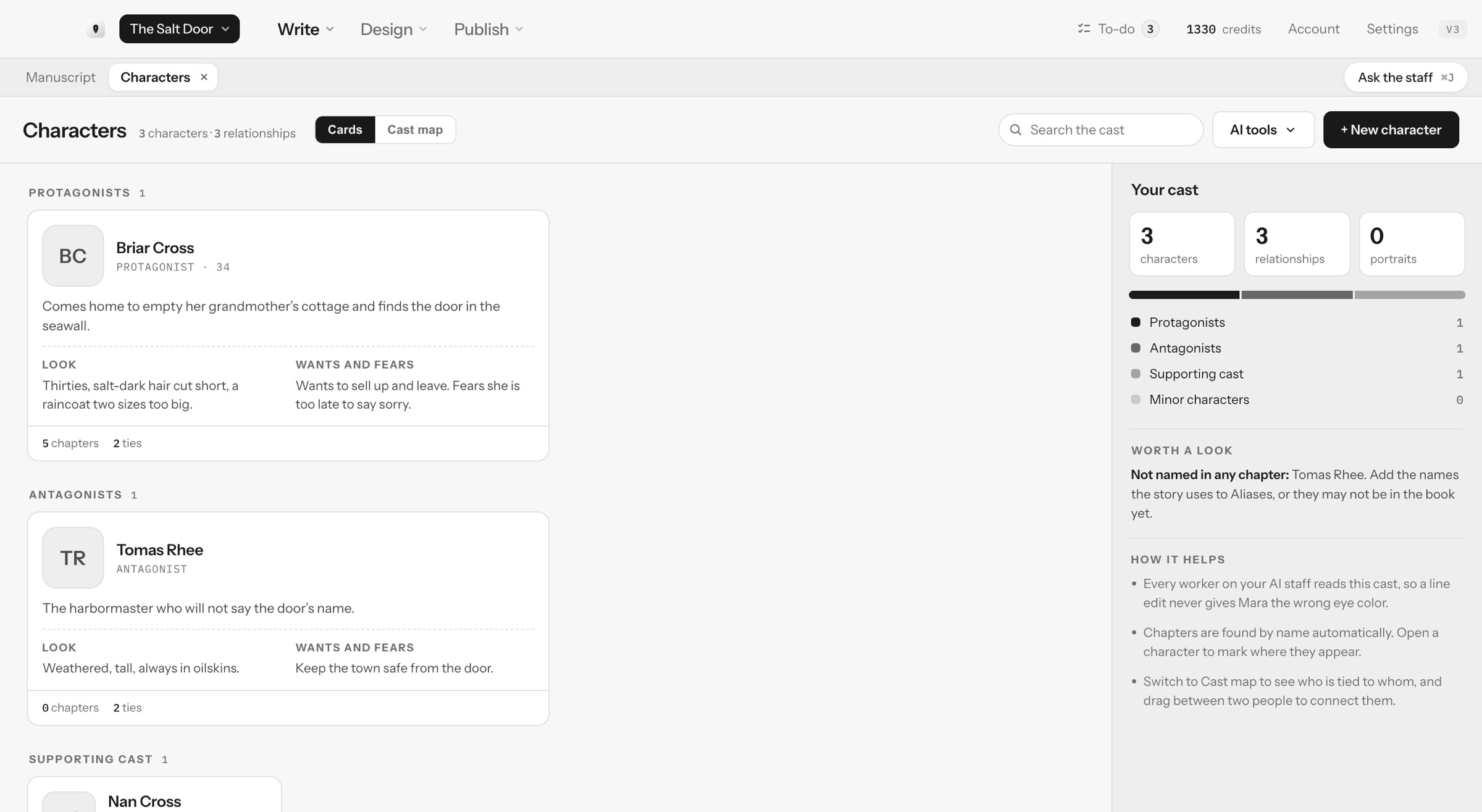
- Characters. Each person gets a card: a line on who they are, other names, age, appearance, personality, what they want and fear, voice, backstory, where they live and notes, with a picture if you have one.
- Cast map. Drag from one person to another and name the tie between them: friend, rival, parent of.
- World map. Pin your places on a map made for this book, or upload your own drawn or painted map and pin onto that. Places can sit inside other places, from a realm down to a single room. Draw the roads, paths, rivers, sea routes and secret ways between them, and label each one, such as two days by horse.
- Found by name. A strip shows each chapter where a character or place is named, and how often. A character's other names count too. Inkbound also points out anyone not named in any chapter, and anyone with no look written down.
- Filled from your draft. Starting from a finished manuscript? The AI can fill the Story Bible from it, and you tick what to keep. It uses AI credits, and you see the estimate first.
- Read by your AI staff. Every member of your AI staff reads the Story Bible along with your chapters, so the staff works from the same facts you do. When the staff suggests a new character or place, it arrives as a card, and nothing changes until you press Apply.
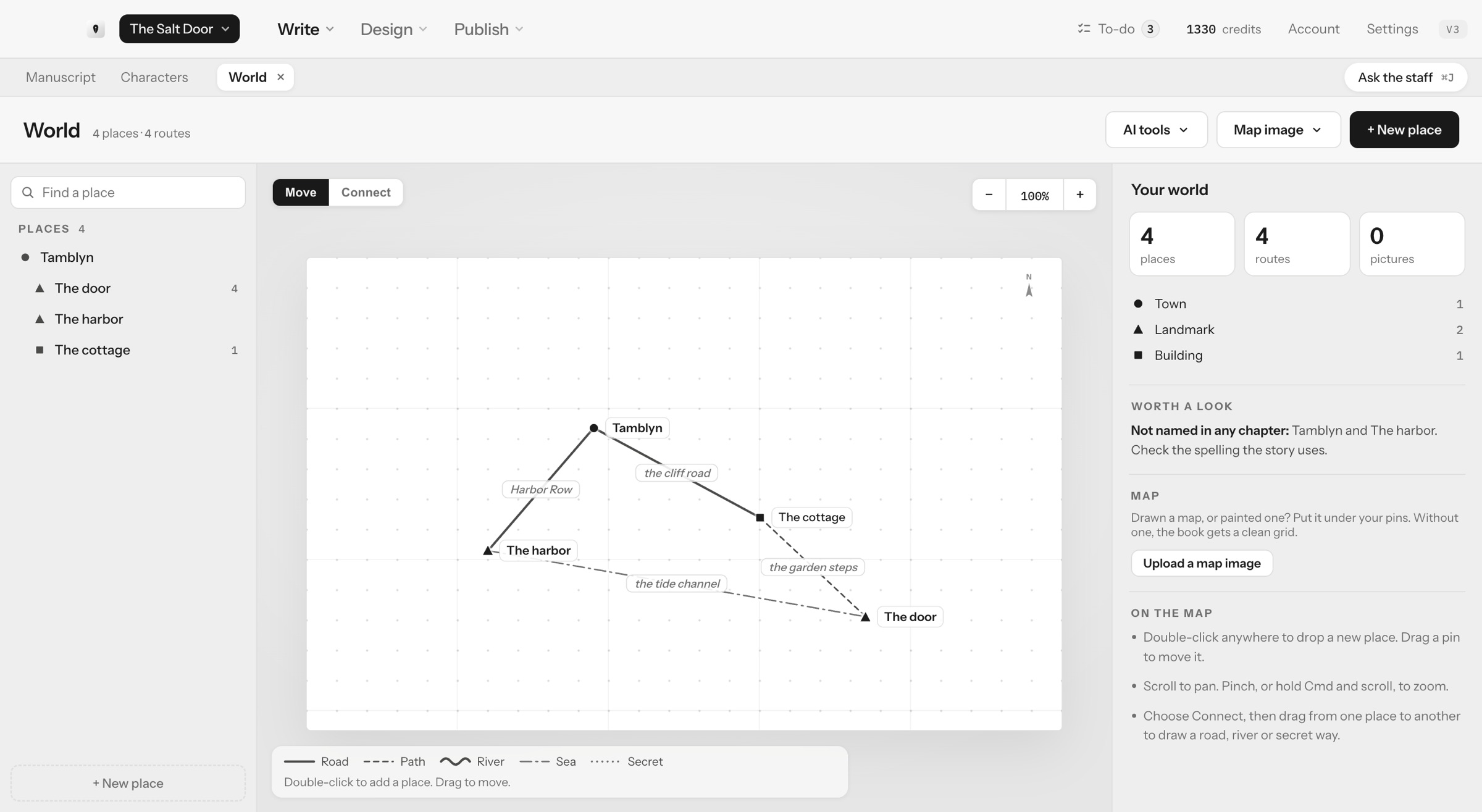
Each book keeps its own Story Bible. Books join a series when they share a series name and a book number, and sorting the Library by series puts them together in reading order. Inkbound's Story Bible holds characters and places, so keep the timeline, world rules and style sheet from this template in the Notes on a character or place, or in a separate document. A place's description is a good home for the rules that hold there.
See where the Story Bible fits in how Inkbound works, from the first chapter to the files you upload. Weighing it against a drafting app you already know? Here is Inkbound vs Scrivener. Inkbound runs on Apple Silicon Macs with macOS 12 or later, and it needs a plan: $1 for your first 7 days, then $14.99 a month until you cancel, or Lifetime for $129 once, for as long as we offer Inkbound. Every new account includes 50 AI credits to try the AI staff. Compare Monthly or Lifetime.