A book blurb is the short pitch on your back cover and your Amazon page. It introduces a character with a problem, shows what that problem could cost them, and stops on a question only the book can answer. Most blurbs run about 100 to 200 words, and KDP's own advice for the Amazon description is to aim for a 150-word paragraph.
That is the whole job in three sentences. The rest of this guide shows how to write a book blurb that does it well: the formula, a template, five worked examples, and the rules KDP applies when the same words become your Amazon description.
The formula at a glance
Hook line, then who and where, then what goes wrong, then what it will cost them, then the open question. Jump to the copy-ready blurb template.
What a blurb is, and what it is not
The word gets used for several different pieces of writing, and mixing them up is where a lot of weak blurbs start. Here is how they differ.
| Piece | What it is | Who reads it | Length | Reveals the ending? |
|---|---|---|---|---|
| Blurb | A short pitch for the book, on the back cover or a jacket flap | Readers deciding whether to buy | About 100 to 200 words | No |
| Amazon description | Your blurb in KDP's Description field, shown on your book's Amazon page | Shoppers on Amazon | KDP suggests a 150-word paragraph; the field takes up to 4,000 characters | No. KDP does not accept spoilers there |
| Synopsis | A summary of the whole plot | Agents, editors and contests | Whatever the request asks for | Yes |
| Endorsement blurb | A line of praise from another author or a reviewer | Readers, as a sign of trust | One or two sentences | No |
| Tagline | One line that sums up the book's promise | Anyone glancing at the cover or an ad | One sentence | No |
Two of these trip people up. A synopsis tells the whole story, ending included, because an agent or editor needs to see that the plot works. A blurb does the opposite: it sells the beginning and keeps the ending back. And "blurb" also means a line of praise from another writer, the kind printed on a front cover. If an author offers to blurb your book, that is what they mean.
Where the blurb sits depends on the binding. On a paperback, or a hardcover without a dust jacket, it goes on the back cover. On a hardcover with a jacket, it usually sits on the front flap, which leaves room for a slightly longer version. Writing a book jacket blurb works the same way; the flap just gives you more space. Online, the blurb becomes your Amazon description.
How long should a book blurb be?
It depends on where the words will live. The same blurb has two homes, and each has its own limit.
| Where | Aim for | The hard limit |
|---|---|---|
| Amazon description | A 150-word paragraph, as KDP suggests | 4,000 characters, HTML tags included |
| Paperback back cover | About 100 to 200 words, fewer on a small trim | The back panel: text 0.125 in inside the trim, out of the spine, clear of the barcode area |
| Hook line or tagline | One sentence | None, but shorter lands harder |
On Amazon
KDP's Description field takes up to 4,000 characters, but KDP's own advice points the other way. It says to describe only the main plot, theme or idea, for a reader who is deciding in a second or two whether to find out more, and to aim for a 150-word paragraph with sentences that are easy to scan. Use the room for clarity, not for more plot.
On the back cover
The back cover is a fixed box, and the blurb shares it. Most back covers also carry a hook line at the top, a short author bio, sometimes a photo, and a barcode. If you don't supply your own barcode, KDP places one on the back cover, at the lower right on a left-to-right book, and rejects covers with images or text in that spot. If you supply your own, KDP suggests 2 × 1.2 in, at least 0.25 in from the spine and the trim. KDP also asks for cover text at least 0.125 in inside the trim lines, with no front or back text in the spine area, and type of at least 7 points.
So the space for your blurb is the back panel, minus the margins, the barcode and the bio. A 5 × 8 book's back panel is 5 inches wide; a 6 × 9 panel is 6. Long copy at a readable size runs into the barcode or off the edge, and the usual rescue, shrinking the type, makes the whole cover look crowded. Writing the blurb tight is the better fix.
For the exact size of your back panel, start with your trim and page count. Our guide to KDP book cover size has every measurement, and the KDP cover calculator works out the full wrap for your book.
A practical order: write the Amazon version at about 150 words first. If it does not fit the back cover at a comfortable size, cut it there, starting with the middle. Keep the hook line and the closing question; they do the most work.
The five-part blurb formula
Most blurbs that sell, in almost any genre, answer the same five questions in the same order. Treat it as a shape, not a script.
- The hook line. One sentence that makes a stranger want the next one: a strange situation, a sharp promise or a line with real voice. KDP's advice for descriptions is the same. Write a first sentence that draws readers in, and show what genre the book belongs to.
- Who and where. Your main character, by name, with one detail that makes them specific, and the world in a phrase. Not their backstory. Just enough to care.
- What goes wrong. The event that knocks them off course. In most novels it happens early, so the blurb stays in the first act and gives away nothing from the second half.
- What it will cost them. The stakes, made personal. "The kingdom will fall" is abstract. "She will lose her brother" is a reason to keep reading.
- The open question. End on the choice, the danger or the mystery the book resolves, without resolving it. One question, stated or implied.
Nonfiction uses a similar shape with different parts: the reader's problem, the promise of the book, why the author can deliver it, what is inside, and the result the reader gets.
Book blurb template, ready to copy
[Hook line: one sentence, a strange situation or a sharp promise.]
[Character], [one detail that makes them specific], [where they live or what they do]. When [the thing that goes wrong], [what they now have to do].
But [the obstacle, the opponent or the deadline]. If they fail, [what they will lose].
[The open question, or the choice they face.]
[Optional: a genre or series line, such as "A slow-burn small-town romance" or "The first book in an epic fantasy trilogy."]
Nonfiction blurb template
[The reader's problem or goal, in their own words.]
[Why the usual approach fails.] [Author], [the real experience that qualifies them], shows [the promise of the book].
Inside, you'll learn: [three to five specific things, as a bulleted list].
[The result, and who the book is for.]
Fill in the parts before you write sentences
Answer each part in a few plain words first. For the thriller example below, the notes looked like this:
- Hook: a 911 call from her own address.
- Who and where: Nora, a night-shift 911 dispatcher in Tacoma.
- What goes wrong: the caller is inside her house, and her son vanishes.
- What it will cost her: her son.
- Open question: who is calling, and what will Nora break to get him back?
Once the notes are right, the sentences are mostly a matter of voice: short lines for a thriller, warmth for a romance, a little wit for a cozy. Then read the blurb aloud. Anything you stumble over, a reader will skim past.
Book blurb examples by genre
Each example below was written for this guide, for a book that does not exist. The notes after each one show which part of the formula each sentence does, followed by what readers of that genre look for.
Romance blurb example
Romance · invented for this guide
Some people leave town. Ivy Marsh left a ring on the counter.
Ten years later, Ivy is back in Pell Harbor, Maine, to sell her late grandmother's bakery before the winter rent comes due. There is exactly one offer. It comes from Theo Lund, the man whose proposal she turned down the night she caught the bus to Boston.
Theo wants the building, not the past. Ivy has three weeks, an oven that only works if you kick it, and a recipe box full of her grandmother's notes, half of them addressed to Theo.
Selling means losing the last of her family. Staying means facing the reason she ran. And the more Ivy reads, the clearer it gets that her grandmother had plans for both of them.
A warm, slow-burn second-chance romance about going home.
- Hook: two short sentences set up a history and make you ask why she left.
- Who and where: Ivy, a small Maine town, a bakery. One detail each, no backstory.
- What goes wrong: the only buyer is the man she left.
- Cost: the family bakery or her pride. Both choices hurt, which is what makes stakes work.
- Open question: what was her grandmother planning?
- Genre line: "slow-burn" and "second-chance" tell romance readers the pace and the trope.
Romance notes. Romance readers want to meet both leads, see what keeps them apart, and know the flavor before they buy: the trope, the pace, the heat level and the setting. A happy ending is part of the genre's promise, so the open question is how the two of them get there, never whether.
Thriller blurb example
Thriller · invented for this guide
The call came in at 3:14 a.m. The address on the screen was her own.
Nora Vance has worked the night shift at a Tacoma 911 center for eleven years. She knows how to keep a frightened stranger talking. But the woman whispering on this line is inside Nora's house, where her twelve-year-old son is asleep, and she knows things about Nora that no stranger should.
By the time a patrol car arrives, the house is empty. No caller. No son. Only a phone on the kitchen table, and a voice that will speak to no one but Nora.
Nora has a rule for every emergency. To bring her son home, she will have to break every one of them.
- Hook: a situation anyone understands at once, with the twist in the second sentence.
- Who and where: a job that gives her skills, which makes the reader curious how she will use them.
- What goes wrong: the call, then the empty house. It is the opening of the story, and the blurb stays there.
- Cost: her son. Nothing abstract.
- Open question: who is calling, and what will she break? The last line turns her training against her.
Thriller notes. Thriller blurbs run short and fast: short sentences, a clock, a threat that is personal. Say exactly what is at risk, and cut every name that is not the hero, the victim or the villain.
Epic fantasy blurb example
Epic fantasy · invented for this guide
In Varn, every oath is binding. Break one, and you never speak again.
Sefa Orrin is an oathkeeper's apprentice, the girl who writes down the promises of kings. She has never broken her word. She has never had to. Then the old queen dies with her last command whispered to one witness, and the witness is Sefa.
Three heirs want the throne, and each needs Sefa to swear she heard their name. One offers her a fortune. One offers her protection. One will kill her if she says anything at all.
But the queen named none of them. And the truth could end a peace that has held for three hundred years.
The first book in an epic fantasy trilogy about loyalty, power and the price of a single word.
- Hook: one rule of the world, with a consequence. That is all the worldbuilding a blurb needs.
- Who and where: Sefa's job ties her to the plot, and the kingdom is a single name.
- What goes wrong: the queen's death leaves Sefa holding the secret.
- Cost: her voice, her life or the peace. Three heirs make the stakes concrete without a map.
- Open question: what did the queen say, and what will Sefa swear?
- Series line: epic fantasy readers want to know they are starting a series.
Fantasy notes. Fantasy blurbs fail most often by opening with history, politics and invented words. Give the reader one rule of the world, one person caught by it, and no more than two or three invented names.
Cozy mystery blurb example
Cozy mystery · invented for this guide
The least popular man in Little Wending has died in the poetry section. Marigold Pike would like her bookshop back.
Gerald Finch reviewed every book he bought, and he hated most of them. When he is found in Marigold's shop, holding a first edition that was never for sale, half the village has a motive. The police are most interested in Marigold, whose shop he called "a jumble sale with a till" in last week's paper.
With the shop sealed the week before the village book fair, and her savings tied up in fair stock, Marigold cannot wait for the police to look elsewhere. She has her aunt, a retired librarian who reads crime novels for research, a shop cat named Quill who goes where he likes, and five days to find out who wanted Gerald dead, before the killer decides she has read enough.
The first Little Wending Bookshop mystery: a clean, cozy whodunit with plenty of tea.
- Hook: a body and a light touch in two sentences, which tells cozy readers the tone before the plot.
- Who and where: a bookseller in a village, the amateur sleuth cozy readers expect.
- What goes wrong: a death in her shop, and she is the suspect.
- Cost: her name, her shop and her savings. Cozy stakes stay small and personal, and that is a feature.
- Open question: who killed him, and will they come for her next?
- Genre line: "clean" and "cozy" tell readers what they will not find.
Cozy notes. Cozy readers buy a series and a setting as much as a mystery. Name the sleuth, the place and the sidekick (a pet counts), keep the violence offstage, and let the tone be a little funny.
Nonfiction blurb example
Practical nonfiction · invented for this guide
You don't need a yard to grow your own vegetables. You need a sunny balcony and a plan.
Most container gardens fail for the same three reasons: the wrong pots, the wrong plants and watering by guesswork. Dana Reyes ran a city plant nursery for fifteen years, answering the same questions from apartment gardeners every spring. This book is her answer, in plain steps.
Inside, you'll learn:
• Which vegetables earn their space in a pot, and which to skip
• How to read your balcony's light in one afternoon
• A watering routine that takes ten minutes a day
• How to plan a season so something is ready to pick every week
Whether you have a narrow balcony or a sunny patio, you can plant your first pots this weekend.
- Hook: the reader's goal and the obstacle they assume, answered in the second sentence.
- The problem: three reasons gardens fail, which shows the author understands the reader.
- Credibility: one line on why this author. Use real experience only.
- What's inside: specific outcomes a reader can picture. KDP's Description field supports bulleted lists.
- Result: who the book is for, and how soon they can start.
Nonfiction notes. Nonfiction readers buy a result. Lead with their problem, not your life story, make each promise specific, and keep only the promises the book actually keeps.
Seven blurb mistakes
- Retelling the plot. A blurb that walks through the story chapter by chapter is a synopsis. Stop at the setup and the stakes. On Amazon, KDP also lists spoilers among the things it cannot accept in a description.
- Too many names. Every name asks the reader to remember something. Keep to two or three people and one place.
- Opening with the world instead of the person. History, politics and backstory can wait for the book. Readers attach to a person first.
- Vague stakes. "Nothing will ever be the same" could be printed on any book. Say what this character stands to lose.
- A stack of questions. "Will she find him? Can she trust him? What is the secret?" One question at the end is a hook. Three in a row is a quiz.
- Praising your own book. "Gripping," "unputdownable" and "a must-read" tell the reader nothing. Show the story, and leave the praise to readers and other authors.
- Selling a different book. A blurb that promises a thriller on top of a quiet literary novel brings in the wrong readers and disappoints them. KDP's content guidelines also say it does not allow descriptive content meant to mislead customers, or that doesn't accurately represent the book.
Then proofread it more than once. KDP's advice is that a description should be polished, with no misspellings or grammatical errors, and that it helps to show it to others for a fresh set of eyes.
Your Amazon book description: the same blurb, KDP's rules
How to write a book description for Amazon is mostly how to write a blurb, plus a few rules. On Amazon, your blurb becomes the book description, the text shoppers read on your book's page. In KDP, you enter it under Description when you edit a book's details. KDP's guidance fits in three words: simple, compelling and professional.
The 4,000-character limit counts HTML
KDP's limit is 4,000 characters, and its editor counts every character you use, HTML tags included, whether you type in the text view or the source view. KDP's own example: the word "test" counts as 4 characters, and once you bold it, it counts as 11, because the bold tags count too. A heavily formatted description reaches the limit sooner than its word count suggests.
The HTML KDP supports
You can format the description with KDP's text editor or with basic HTML. These are the tags KDP lists:
| Tag | What it does |
|---|---|
<br> | A line break. Use two in a row for an empty line between paragraphs. |
<p> | A paragraph, with a line break after it. |
<b> | Bold. |
<i> and <em> | Italic, and emphasis, which usually shows as italic. |
<u> | Underline. |
<h4> to <h6> | Section headings, from largest to smallest. KDP does not support <h1>, <h2> or <h3>. |
<ul> and <ol> | A bulleted or numbered list, with each item in <li>. |
Two small traps: double spaces between words don't show on your book's page, and a tag like <b> needs both its opening and its closing tag. Here is how the thriller blurb's opening looks with a bold hook line and an empty line after it:
<b>The call came in at 3:14 a.m. The address on the screen was her own.</b><br><br>Nora Vance has worked the night shift...
What KDP will not accept in a description
KDP lists these as things it cannot accept in a book description:
- Pornographic, obscene or offensive content
- Phone numbers, mailing addresses, email addresses or website URLs
- Reviews, quotes or testimonials
- Requests for customer reviews
- Advertisements, watermarks on images or videos, or promotional material
- Time-sensitive information, such as the dates of a tour, seminar or lecture
- Availability, price or other ways to order, such as links to other websites
- Spoilers
- Unicode emojis
- Keywords or book tag phrases
Two of these change how you adapt a back-cover blurb. An endorsement quote that works on the printed cover has to come out of the Amazon version. And search phrases belong in KDP's seven keyword slots, not in the description; here is how to choose your seven KDP keywords. With the description written, the rest of the listing is your KDP categories and, if you want images on your book's Amazon page too, A+ Content.
Writing your blurb in Inkbound
Inkbound is a Mac app that carries a book from draft to KDP files in one project, and the blurb is part of that project. Two places in the app work with it.
The Blurb Writer drafts. You decide.
The Blurb Writer is one of Inkbound's AI writing staff. Ask it in the chat for a back-cover blurb, an Amazon description or a tagline. When you message the staff, it gets your whole book: every chapter, the synopsis and your Story Bible. So its drafts start from the story itself, not from a summary you paste in. In the Listing, one button asks it for a description and seven keywords.
A draft is a starting point. Ask for two or three angles, then hold each one against the five parts above. Cut anything the book does not deliver, and rewrite it until it sounds like you. You keep the pen and choose what goes in. The Blurb Writer uses AI credits, and every new account includes 50 of them.
The Cover lab sets it on the back cover
In the Cover lab, the back cover holds a hook line, your blurb and an author bio with a photo. Leave the blurb empty and the description from your Listing is used instead. Change a line of copy and the cover updates, with no repaint and no credits. If the back copy runs into the barcode area or the page edge, Inkbound tells you before you export and points to the fixes: shorten the blurb or the bio, or lower the back text size.
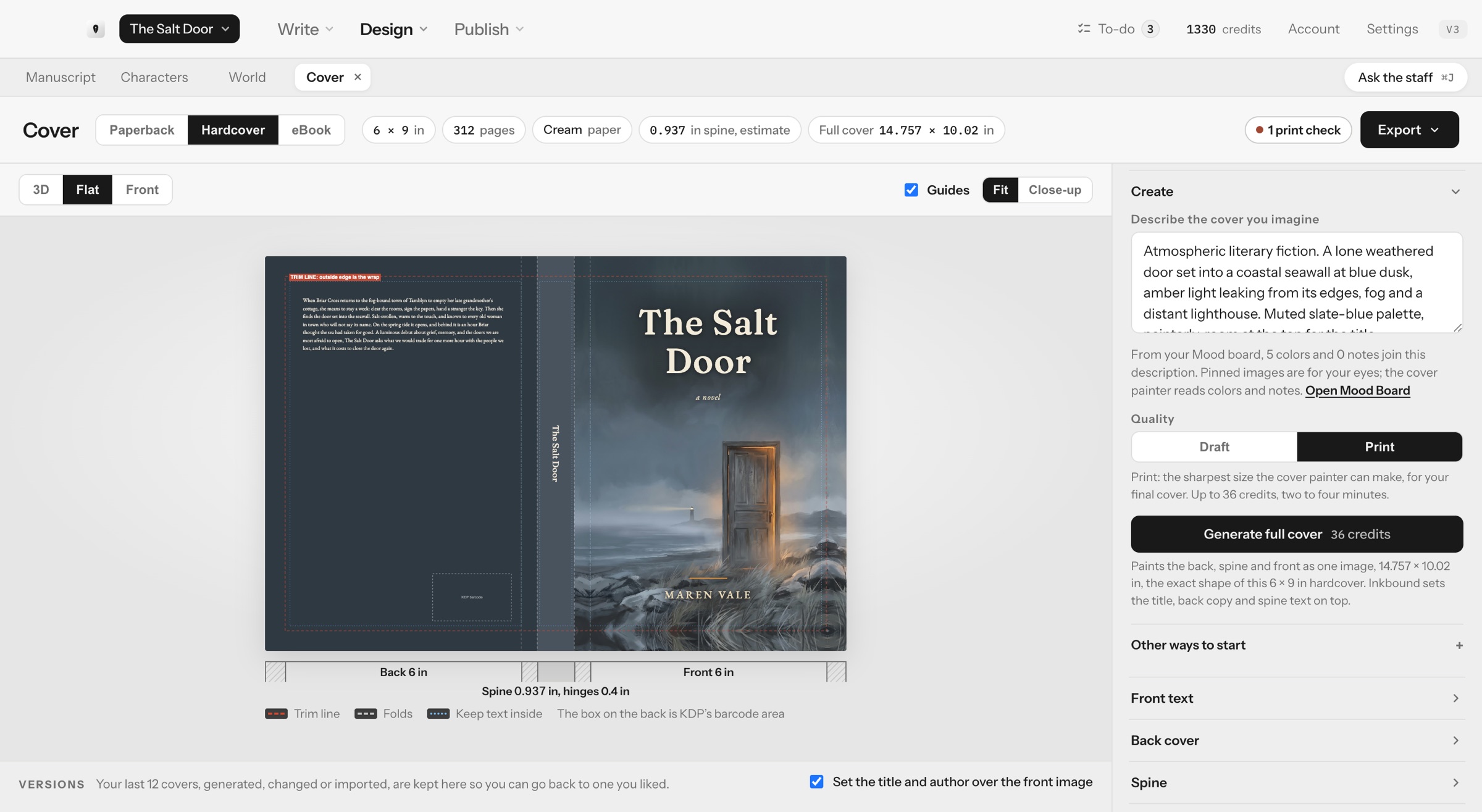
On the Amazon side, the Listing counts your description as the HTML KDP receives, against the 4,000-character limit, and Copy as KDP HTML carries bold, italics, lists and headings over to KDP. See how Publish and the Listing work.
When you publish, KDP asks you to tell it about any text, images or translations in your book that an AI tool created. Here is what KDP asks you to disclose.
With the blurb done, the rest of the upload is in our step-by-step guide on how to self-publish a book on Amazon.
KDP details checked on October 22, 2026, against KDP's help pages on writing a book description, barcodes, paperback covers and content guidelines. KDP updates its pages from time to time, so check the current rules before you publish.